
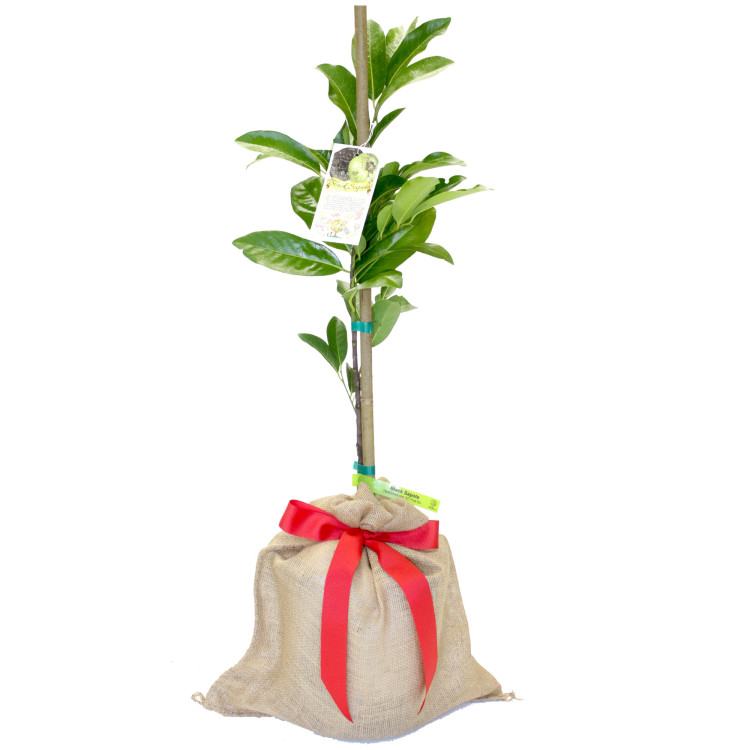
Black Sapote Tree
$ 92.75
- Common name: Black Sapote, Chocolate Pudding Fruit, Black/Chocolate Persimmon Botanical name: Diospyros digyna Family: Ebanaceae Avg Height X Width: 25' x 25' Origin: Mexico Season: Fall and Spring Damage temp: 28-30 F Black Sapote Tree in a 3 Gallon Container. Often called Chocolate pudding fruit, the black sapote is an evergreen, handsome tree with dark green, glossy leaves. Fruit are greenish-brown when ripe having a thin skin and chocolate colored pulp. A spoonful of honey mixed into the pulp makes it glossy, shiny and tasty, living up to its popular name of Chocolate Pudding Fruit. They can be grown in containers and will reach heights of 10-12 feet. DescriptionOrigin and DistributionVarietiesClimateSoilPropagationCultureSeasonHarvestingYieldKeeping QualityFood UsesFood ValueToxicityOther UsesMedicinal Uses The black sapote is not, as might be assumed, allied to either the sapote (Pouteria sapota H.E. Moore & Stearn) or the white sapote (Casimiroa edulis Llave & Lex.). Instead, it is closely related to the persimmon in the family Ebenaceae. For many years it has been widely misidentified as Diospyros ebenaster Retz., a name confusingly applied also to a strictly wild species of the West Indies now distinguished as D. revoluta Poir. The presently accepted binomial for the black sapote is D. digyna Jacq. (syn. D. obtusifolia Humb. & Bonpl. ex Willd.). In Spanish, it is known variously as sapote, sapote negro, zapote, zapote negro, zapote prieto, zapote de mico, matasano (or matazano) de mico, or ebano. It has been called black persimmon in Hawaii. Description The tree is handsome, broad-topped, slow-growing, to 80 ft (25 m) in height, with furrowed trunk to 30 in (75 cm) in diameter, and black bark. The evergreen, alternate leaves, elliptic-oblong to oblong-lanceolate, tapered at both ends or rounded at the base and bluntly acute at the apex, are leathery, glossy, 4 to 12 in (10-30 cm) long. The flowers, borne singly or in groups of 3 to 7 in the leaf axils, are tubular, lobed, white, 3/8 to 5/8 in (1-1.6 cm) wide, with persistent green calyx. Some have both male and female organs, large calyx lobes and are faintly fragrant; others are solely male and have a pronounced gardenia-like scent and a few black specks in the throat of the corolla. The fruit is bright-green and shiny at first; oblate or nearly round; 2 to 5 in (5-12.5 cm) wide; with a prominent, 4-lobed, undulate calyx, 1 1/2 to 2 in (4-5 cm) across, clasping the base. On ripening, the smooth, thin skin becomes olive-green and then rather muddy-green. Within is a mass of glossy, brown to very dark-brown, almost black, somewhat jelly-like pulp, soft, sweet and mild in flavor. In the center, there may be 1 to 10 flat, smooth, brown seeds, 3/4 to 1 in (2-2.5 cm) long, but the fruits are often seedless. Origin and DistributionThe black sapote is native along both coasts of Mexico from Jalisco to Chiapas, Veracruz and Yucatan and in the forested lowlands of Central America, and it is frequently cultivated throughout this range. It was apparently carried by the Spaniards to Amboina before 1692, and to the Philippines long before 1776, and eventually reached Malacca, Mauritius, Hawaii, Brazil, Cuba, Puerto Rico and the Dominican Republic. In 1919, seeds from Guadalajara, Mexico, were sent to the Bureau of Plant Industry of the United States Department of Agriculture; cuttings and seeds were received from the Isle of Pines, Cuba, in 1915; seeds arrived from Hawaii in 1916 and 1917; others from Oaxaca, Mexico, in 1920. Numerous seedlings have been grown in southern California but all have been killed by low temperatures. The tree does very well in southern Florida, though it has been grown mainly as a curiosity. Outside of its homeland, the fruit has not achieved any great popularity. In Mexico, the fruits are regularly marketed.Varieties Certain trees tend to bear very large, seedless or nearly seedless fruits maturing in summer instead of winter as most do, but no varietal names have been attached to them in Florida. ClimateThe black sapote is not strictly tropical inasmuch as it is hardy as far north as Palm Beach County, Florida, if protected from frost during the first few years. Trees that have become well established have withstood occasional brief exposures to 28º or 30º F (-2.22º or-1.11º C). In Mexico, the tree is cultivated up to elevations of 5,000 or even 6,000 ft (1,500-1,800 m). SoilThe tree has a broad adaptability as to terrain. In Mexico it grows naturally in dry forests or on alluvial clay near streams or lagoons where it is frequently subject to flooding. Nevertheless, it thrives on moist sandy loam, on well-drained sand or oolitic limestone with very little top-soil in southern Florida. It is said to flourish on all the soils of Cuba. PropagationThe black sapote is usually grown from seeds, which remain viable for several months in dry storage and germinate in about 30 days after planting in flats. Vegetative propagation is not commonly practiced but the tree has been successfully air-layered and also shield-budded using mature scions. CultureSeedlings are best transplanted to pots when about 3 in (7.5 cm) high and they are set in the field when 1 to 2 years old, at which time they are 1 to 2 ft (30-60 cm) in height. They should be spaced at least 40 ft (12 m) apart. Most begin to bear in 5 to 6 years but some trees may take somewhat longer. The tree is naturally vigorous and receives little or no cultural attention in Florida though it has been noted that it benefits from fertilization. SeasonIn Mexico, the fruits are common in the markets from August to January. Most black sapotes in Florida ripen in December, January or February. Certain trees, especially the large-fruited types, regularly come into season in June, others in July and August. HarvestingIt is difficult to detect the slight color change of mature fruits amid the dense foliage of the black sapote tree. Many black sapotes ripen, fall and smash on the ground before one has the chance to pick them, and this is one reason why .the tree is not favored for landscaping in urban areas. An experienced picker can harvest the fruits at the green-mature or olive-green stage with a cutting pole equipped with a cloth sack. YieldNo yield figures are available but the tree is noted for bearing well. In 1899, the annual crop in Mexico was valued at $27,000, a considerable sum at that time. Keeping QualityFruits picked when full-grown but unripe (bright-green) have ripened in 10 days at room temperature. Therefore it is at this stage that they must be picked for marketing and shipping. Firm, olive-green fruits will ripen in 2 to 6 days. Fruits displayed on markets in Mexico are somewhat shriveled and wrinkled. The black sapote is very soft when fully ripe. Though it may remain fit for eating if held for a few days in cold storage, it is too soft to stand handling. Food UsesUnkind writers have employed unflattering phrases in describing the flesh of the black sapote and have probably hindered its acceptance. This seems quite unreasonable because the color and texture of the pulp closely match stewed prunes, to which there seems to be no aesthetic objection. In the Philippines, the seeded pulp is served as dessert with a little milk or orange juice poured over it. The addition of lemon or lime juice makes the pulp desirable as a filling for pies and other pastry. It is also made into ice cream. In Mexico, the pulp may be mashed, beaten or passed through a colander and mixed with orange juice or brandy, and then served with or without whipped cream. Also, they sometimes mix the pulp with wine, cinnamon and sugar and serve as dessert. Some Floridians use an eggbeater to blend the pulp with milk and ground nutmeg. A foamy, delicious beverage is made by mixing the pulp with canned pineapple juice in an electric blender. In Central America, the fermented fruits are made into a liqueur somewhat like brandy. Food Value Per 100 g of Edible Portion (Flesh)*Moisture 79.46-83.1 g Protein 0.62-0.69 g Carbohydrates 12.85-15.11 g Fat 0.01 g Ash 0.37-0.6 g Calcium 22.0 mg Phosphorus 23.0 mg Iron 0.36 mg Carotene 0.19 mg Thiamine Riboflavin 0.03 mg Niacin 0.20 mg Ascorbic Acid** 191.7 mg *According to analyses in Mexico and Guatemala. **The ascorbic acid content is said to be about twice that of the average orange. ToxicityUnripe black sapotes are very astringent, irritant, caustic and bitter, and have been used as fish poison in the Philippines. Other UsesWood: The wood is yellowish to deep-yellow with black markings near the heart of old trunks; compact and suitable for cabinetwork but little used. Reports of dark wood utilized for furniture are probably the result of confusion with other species of Diospyros. Medicinal_UsesThe crushed bark and leaves are applied as a blistering poultice in the Philippines. In Yucatan, the leaf decoction is employed as an astringent and is taken internally as a febrifuge. Various preparations are used against leprosy, ringworm and itching skin conditions.
- Brand
- Need this Tool Customized?
Brand
LMT
Need This Tool Customized?
Every machining application is different. If this tool is close to what you need but not an exact fit, General Cutting Tools can help modify it for your specific job, machine, material, or production requirement.
We work with CNC shops, industrial manufacturers, tool rooms, and production facilities to provide tool modifications that improve fit, function, performance, and efficiency. Whether you need a small adjustment or a more specialized cutting tool solution, our team can review your requirements and recommend the best option.
Custom tool modifications can help reduce setup time, improve accuracy, extend tool life, solve clearance issues, and support more consistent production results.
Common Tool Customization Options
Diameter and OD Modifications
We can modify tool diameters to better match your application requirements, including cutting diameter changes, OD modifications, pilot diameter adjustments, step diameters, and shank diameter modifications.
Bore Modifications for Saw Blades
Custom saw blade bore modifications are available for hole diameter changes, pinholes, mounting holes, and keyway cutouts to help match your machine setup and cutting requirements.
Length Adjustments
Tools can be modified for specific reach, clearance, or setup needs. This may include overall length changes, flute length adjustments, reduced neck sections, extended reach designs, or shortened tools for improved rigidity.
Shank Modifications
Shank modifications can help ensure the tool fits properly in your holder, spindle, or machine setup. Common options include shank diameter changes, flats, Weldon flats, reduced shanks, and custom holding requirements.
Radius, Chamfer, and Corner Changes
We can customize corner radius, chamfer angles, edge breaks, and other profile details to meet part print requirements or improve cutting performance.
Step Tool Modifications
For applications that require multiple diameters or operations in a single tool, we can create or modify step tools to help reduce tool changes and improve production efficiency.
Flute and Cutting Edge Adjustments
Depending on the tool and application, flute length, cutting edge geometry, end cutting features, relief angles, and cutting edge shape may be modified to improve chip evacuation, cutting action, and tool performance.
Regrinding and Resharpening
Many cutting tools can be reground or resharpened to restore performance, extend tool life, and reduce replacement costs.
Custom Profiles and Special Forms
For unique part features, we can help provide special forms, custom profiles, custom radii, counterbores, countersinks, keyseat cutters, form tools, and other application-specific tooling solutions.
Material-Specific Tool Adjustments
We can help modify or recommend tooling based on the material being machined, including aluminum, brass, bronze, plastics, stainless steel, hardened steel, cast iron, composites, and other industrial materials.
Have a Drawing, Sample, or Part Print?
Send us your print, sketch, CAD file, photo, tool number, sample, or application details. For the fastest quote, include the material being cut, quantity needed, required dimensions, tolerances, and any machine or holder requirements.
Coating Options
Tool coatings can be selected or added to improve wear resistance, heat resistance, lubricity, and performance in specific materials such as steel, stainless steel, aluminum, cast iron, and high-temperature alloys.
Request a Custom Tool Modification
Need this tool changed for your application? Contact General Cutting Tools today to discuss your custom tooling needs. We can help you find the right solution for your machine, material, and production goals.
Related products
Adjustable Milling System
$ 2.60
Adjustable Milling System
$ 10.66
Adjustable Milling System
$ 7.10
Adjustable Milling System
$ 3.14
Adjustable Milling System
$ 8.61
Adjustable Milling System
$ 8.42
Adjustable Milling System
$ 3.28
Adjustable Milling System
$ 2.95