
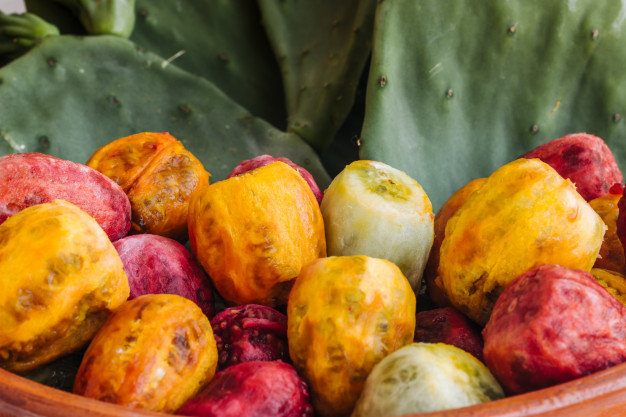
Prickly Pear/Tuna Plant
$ 94.15
- Prickly Pear/Tuna Plant in a 3 Gallon Container. Imagine a plant which can provide you with several year-round foods, as well as a sweetener, an ice cream flavoring, a red dye, a hair conditioner, flour, and still be a drought tolerant burglar fence. This versatile plant is the prickly pear cactus, providing food, medicine, dye, and landscaping. The pads, fruits, seeds, and flowers of the prickly pear are all edible and can be prepared in a variety of ways. The fruit tast similiar to a watermelon. Prickly pear planted around the perimeter of your yard provides a steady supply of food, and serves as a natural fence through which most animal and human intruders will not penetrate. An edible fence or hedge. Description Food Medicinal Uses Description Prickly pear cacti typically grow with flat, rounded platyclades that are armed with two kinds of spines; large, smooth, fixed spines and small, hairlike spines called glochids that easily penetrate skin and detach from the plant. Many types of prickly pears grow into dense, tangled structures. Prickly pear species are found in abundance in the West and Southwest of the United States and throughout much of Mexico. Prickly pears are also the only types of cactus natively found to grow in the eastern United States. Opuntia are the most cold-tolerant of the lowland cacti, extending into western and southern Canada; one subspecies, Opuntia fragilis var. fragilis, has been found growing along the Beatton River in central British Columbia, southwest of Cecil Lake at 56° 17’ N latitude and 120° 39’ W longitude. Charles Darwin was the first to note that these cacti have thigmotacticanthers: when the anthers are touched, they curl over, depositing their pollen. This movement can be seen by gently poking the anthers of an open Opuntia flower. The same trait has evolved convergently in other cacti Food The fruit of prickly pears, commonly called cactus figs, Indian fig or tuna, is edible, although it has to be peeled carefully to remove the small spines on the outer skin before consumption. If the outer layer is not properly removed, glochids can be ingested causing discomfort of the throat, lips, and tongue as the small spines are easily lodged in the skin. Native Americans like the Tequesta would roll the fruit around in suitable medium (e.g. grit) to "sand" off the glochids. Today, parthenocarpic (seedless) cultivars are also available. Cactus figs are often used to make candies and jelly and a refreshing drink. The fruit is a favourite in Sicilian cuisine, where it is called ficurinnia (Indian fig). Opuntia ficus-indica has been introduced to Europe and flourishes in areas with a suitable climate, such as the south of France, southern Italy, Sicily where they are referred to as fichi d'India (Indian figs), along the Struma River in Bulgaria, in Southern Portugal and Madeira where they are called tabaibo or "Indian figs", and eastern and southern Spain as well as Gibraltar where they are known as chumbo or higo chumbo ("chumbo fig"). In Greece it grows in such places as Corfu and its figs are known as frangosyka (French figs) or pavlosyka (Paul's figs). The figs are also grown in Cyprus, where they are known as papoutsosyka (shoe figs). The prickly pear also grows widely on the islands of Malta where it is enjoyed by the Maltese as a typical summer fruit (known as Bajtra tax-Xewk) as well as being used to make the popular liqueur known as Bajtra. The prickly pear is so commonly found in the Maltese islands that it is often used as a dividing wall between many of Malta's characteristic terraced fields in place of the usual rubble walls. Tungi is the local St. Helenian name for cactus pears. The plants (Indian Fig Opuntia) were originally brought to the island by the colonial ivory traders from East Africa in the 1850s. Tungi cactus now grows wild and organically in the dry coastal regions of the island. Three principal cultivars of tungi grow on the island: the 'English' with yellow fruit; the 'Maderia' with large red fruit; and the small firm 'Spiny Red'. The young stem segments, usually called nopales, are also edible in most species of Opuntia. They are commonly used in Mexican cuisine in dishes such as huevos con nopales (eggs with nopal), or tacos de nopales. Nopales are also an important ingredient in New Mexican cuisine. Medicinal Uses Most species of Opuntia contain a range of alkaloids in ample quantities, notably substituted phenethylamines. While the mere presence of such compounds has been confirmed in many species without further details, they have been studied more thoroughly in others. Identified compounds of medical significance include 3-methoxytyramine, candicine, hordenine, N-methyltyramine and tyramine. The stem of certain Opuntia spp. can be used to treat type II diabetes, diarrhea, and stomach ache. However, usefulness of Opuntia in treating diabetes is not at all resolved. Although some researchers have shown a blood glucose-lowering effect of O. streptacantha, another study of three other species of Opuntia (O. lasiacantha, O. velutina, and O. macrocentra, and , and , and , and , and , and , , and ) showed no such effect. Yet another study, raised concern about toxic effects on the kidney. It may be that certain species are effective and useful in diabetes while others are not but this needs to be clarified with further research before recommending its use. Furthermore, when buying nopal in the market, it is impossible to know which species one is buying and therefore whether or not it is useful in treating diabetes. Indian Fig Opuntia (and probably others) might have a reducing effect on alcohol hangover by inhibiting the production of inflammatory mediators. Studies have yielded differing results, with some studies witnessing significant reductions in nausea, dry mouth, and loss of appetite as well as less risk of a severe hangover while others witnessing no compelling evidence for effects on alcohol hangover The gel-like sap of prickly pears can be used as hair conditioner.
- Brand
- Need this Tool Customized?
Brand
LMT
Need This Tool Customized?
Every machining application is different. If this tool is close to what you need but not an exact fit, General Cutting Tools can help modify it for your specific job, machine, material, or production requirement.
We work with CNC shops, industrial manufacturers, tool rooms, and production facilities to provide tool modifications that improve fit, function, performance, and efficiency. Whether you need a small adjustment or a more specialized cutting tool solution, our team can review your requirements and recommend the best option.
Custom tool modifications can help reduce setup time, improve accuracy, extend tool life, solve clearance issues, and support more consistent production results.
Common Tool Customization Options
Diameter and OD Modifications
We can modify tool diameters to better match your application requirements, including cutting diameter changes, OD modifications, pilot diameter adjustments, step diameters, and shank diameter modifications.
Bore Modifications for Saw Blades
Custom saw blade bore modifications are available for hole diameter changes, pinholes, mounting holes, and keyway cutouts to help match your machine setup and cutting requirements.
Length Adjustments
Tools can be modified for specific reach, clearance, or setup needs. This may include overall length changes, flute length adjustments, reduced neck sections, extended reach designs, or shortened tools for improved rigidity.
Shank Modifications
Shank modifications can help ensure the tool fits properly in your holder, spindle, or machine setup. Common options include shank diameter changes, flats, Weldon flats, reduced shanks, and custom holding requirements.
Radius, Chamfer, and Corner Changes
We can customize corner radius, chamfer angles, edge breaks, and other profile details to meet part print requirements or improve cutting performance.
Step Tool Modifications
For applications that require multiple diameters or operations in a single tool, we can create or modify step tools to help reduce tool changes and improve production efficiency.
Flute and Cutting Edge Adjustments
Depending on the tool and application, flute length, cutting edge geometry, end cutting features, relief angles, and cutting edge shape may be modified to improve chip evacuation, cutting action, and tool performance.
Regrinding and Resharpening
Many cutting tools can be reground or resharpened to restore performance, extend tool life, and reduce replacement costs.
Custom Profiles and Special Forms
For unique part features, we can help provide special forms, custom profiles, custom radii, counterbores, countersinks, keyseat cutters, form tools, and other application-specific tooling solutions.
Material-Specific Tool Adjustments
We can help modify or recommend tooling based on the material being machined, including aluminum, brass, bronze, plastics, stainless steel, hardened steel, cast iron, composites, and other industrial materials.
Have a Drawing, Sample, or Part Print?
Send us your print, sketch, CAD file, photo, tool number, sample, or application details. For the fastest quote, include the material being cut, quantity needed, required dimensions, tolerances, and any machine or holder requirements.
Coating Options
Tool coatings can be selected or added to improve wear resistance, heat resistance, lubricity, and performance in specific materials such as steel, stainless steel, aluminum, cast iron, and high-temperature alloys.
Request a Custom Tool Modification
Need this tool changed for your application? Contact General Cutting Tools today to discuss your custom tooling needs. We can help you find the right solution for your machine, material, and production goals.
Related products
Adjustable Milling System
$ 4.24
Adjustable Milling System
$ 2.60
Adjustable Milling System
$ 8.61
Adjustable Milling System
$ 7.10
Adjustable Milling System
$ 10.66
Adjustable Milling System
$ 5.68
Adjustable Milling System
$ 4.04
Adjustable Milling System
$ 5.68