
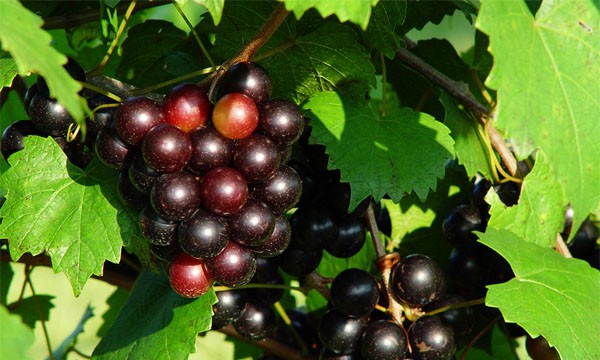
Grape Vine Purple Muscadine Variety
$ 94.29
- Common name: Grapes Botanical name: Vitis rotundifolia Family: Vitaceae Origin: Southwest Asia Avg. Height: Grows on a Vine Grape Vine Purple Muscadine Variety in a 3 Gallon Container. Muscadine grapes are native to the southern United States where they are grown both commercially and in the home garden. Unlike northern grapes, fruits are produced in small clusters or singularly on the vine. There may be a little as 3- 10 grapes per cluster. Muscadines are generally more resistant to disease than bunch grapes. They are also categorized by their color: black (dark purple) or bronze. Origin and History Description Pollination Culture Propagation Rootstocks Planting Desing, Training, Pruning Origin and History Vitis vinifera is thought to be native to the area near the Caspian sea, in southwestern Asia, the same region where apple, cherry, pear, and many other fruits are native. Seeds of grapes were found in excavated dwellings of the Bronze-age in south-central Europe (3500-1000 BC), indicating early movement beyond its native range. Egyptian hieroglyphics detail the culture of grapes and wine making in 2440 BC. The Phoenicians carried wine cultivars to Greece, Rome, and southern France before 600 BC, and Romans spread the grape throughout Europe. Grapes moved to the far east via traders from Persia and India. Grapes came to the new world with early settlement on the east coast, but quickly died out or did poorly. This was due to poor cold hardiness, insect, and disease resistance of Vinifera types. Spanish missionaries brought Vinifera grapes to California in the 1700s and found that they grew very well there. Today, US wine production is dominated by California, although Washington, Oregon, New York, Pennsylvania, and Michigan also have significant commercial wine industries based on Vinifera grapes or French-American hybrids. Vitis labrusca is found growing wild from Maine to the South Carolina Piedmont, west to Tennessee. Today, most Concord grapes are grown in New York and surrounding states. Vitis rotundifolia is native from Virginia south through central Florida, and west to eastern Texas. This species has been enjoyed by southerners since antebellum times, and has received little attention outside of the southeast. Several thousand acres are cultivated in the southeastern states, mostly Georgia, Alabama, and Mississippi. Description Plant All Vitis are "lianas" or woody, climbing vines. Tendrils occur opposite leaves at nodes, and automatically begin to coil when they contact another object. Vinifera and American bunch grapes have loose, flaky bark on older wood, but smooth bark on 1-yr-old wood. Muscadine vines have smooth bark on wood of all ages. Leaves vary in shape and size depending on species and cultivar. Muscadine grapes have small (2-3"), round, unlobed leaves with dentate margins. Vinifera and American bunch grapes have large (up to 8-10" in width) cordate to orbicular leaves, which may be lobed. The depth and shape of the lobes and sinuses (spaces between lobes) varies by cultivar. Leaf margins are dentate. Flower Flowers are small (1/8 inch), indiscrete, and green, borne in racemose panicles opposite leaves at the base of current season's growth. There are 5 each of sepals, petals, and stamens. Ovaries are superior and contain 2 locules each with 2 ovules. The calyptra, or cap is the corolla, in which the petals are fused at the apex; it abscises at the base of the flower and pops off at anthesis. Species in Euvitis may have 100 flowers per cluster, whereas muscadine grapes have only 10-30. Vinifera and Concord grapes are perfect-flowered and self-fruitful, whereas some muscadine cultivars have only pistillate flowers. Pollination Most grapes are self-fruitful and do not require pollinizers; however, pistillate muscadines (e.g., 'Fry', 'Higgins', 'Jumbo') must be interplanted with perfect-flowered cultivars for pollination. Pollination is accomplished by wind, and to a lesser extent insects. Fruit Grapes are true berries; small (<1 inch="" round="" to="" oblong="" with="" up="" 4="" seeds="" figure="" 16="" 1="" berries="" are="" often="" glaucous="" having="" a="" fine="" layer="" of="" wax="" on="" the="" surface="" skin="" is="" generally="" thin="" and="" source="" anthocyanin="" compounds="" giving="" rise="" red="" blue="" purple="" black="" dark="" colored="" grapes="" thinning="" not="" practiced="" for="" most="" types="" crop="" load="" controlled="" through="" meticulous="" pruning="" see="" below="" however="" french-american="" hybrids="" may="" require="" cluster="" development="" quality="" proper="" vine="" vigor="" top="" br=""> Culture Soils and Climate Grapes are adapted to a wide variety of soil conditions, from high pH and slightly saline, to acidic and clayey. Deep, well-drained, light textured soils are best for wine grapes. Highly fertile soils are unsuited to high quality wine production, since vigor and yield must be controlled. Irrigation can be detrimental to grape internal quality, and is sometimes illegal for wine grapes, but is beneficial for table and raisin grapes where high yields are desired. Vinifera grapes can be characterized as requiring Mediterranean climates, as occurs in their native range. Concord and muscadine grapes are better adapted to humid, temperate climates, whereas muscadines require longer growing seasons and milder winters than concord types. Cold hardiness is a major limiting factor for Vinifera grapes. Damage to primary buds occurs at 0 to -10 F, and trunks may be injured or killed below -10°F. Concord grapes are more cold hardy than Vinifera or French-American hybrids, but will experience some damage at -10 to -20 F. Muscadine grapes are the least cold hardy, being killed at temperatures below 0 F, and injured in the single digits F. Winter chilling requirement is highly variable among grape species. Concord grapes generally have high chilling requirements, 1000-1400 hr. Vinifera grapes have low chilling requirements, 100-500 hr, and tend to break bud early and are frost prone in many regions. Muscadines have intermediate chilling requirements, but require several weeks of warm weather following chilling in order to break bud; spring frost is rarely a problem with muscadines. Propagation The most common method of concord and vinifera grape propagation is bench grafting. The most common method of muscadine propagation trench layering, which is done by specialized nurseries. Rootstocks Vitis vinifera was propagated on its own roots from the time of its domestication until about the 1870s. The grape phylloxera (Dactylosphaera vitifolii, Homoptera), also called the grape root louse (actually an aphid), was introduced to Europe from eastern North America in the 1860s, where it caused the most significant pest-related disaster in all of fruit culture. The search for resistant rootstocks led horticulturists to the native range of the phylloxera, where various species of American grapes had coexisted with the pest for millennia, and thus were resistant to it. Initial selections from V. riparia ('Riparia Gloire') and V. rupestris ('Rupestris St. George') were exported to Europe for use as rootstocks with resistance to phylloxera, but unfortunately had low tolerance of the high pH soils of France. V. berlandieri, native to Texas, is tolerant of both high pH and phylloxera, but difficult to root from cuttings; hence hybrids of V. berlandieri and other easy-to-root grapes were made, many of which are used today. Planting Design, Training, Pruning Most grapes are trellised and grown in long, narrow rows spaced about 9-15 ft apart depending on training system. Typically, there is 3-8 ft between vines in a row. Muscadines have similar trellises and row spacings, but are planted 20 ft apart in a row because they are extremely vigorous.
- Brand
- Need this Tool Customized?
Brand
LMT
Need This Tool Customized?
Every machining application is different. If this tool is close to what you need but not an exact fit, General Cutting Tools can help modify it for your specific job, machine, material, or production requirement.
We work with CNC shops, industrial manufacturers, tool rooms, and production facilities to provide tool modifications that improve fit, function, performance, and efficiency. Whether you need a small adjustment or a more specialized cutting tool solution, our team can review your requirements and recommend the best option.
Custom tool modifications can help reduce setup time, improve accuracy, extend tool life, solve clearance issues, and support more consistent production results.
Common Tool Customization Options
Diameter and OD Modifications
We can modify tool diameters to better match your application requirements, including cutting diameter changes, OD modifications, pilot diameter adjustments, step diameters, and shank diameter modifications.
Bore Modifications for Saw Blades
Custom saw blade bore modifications are available for hole diameter changes, pinholes, mounting holes, and keyway cutouts to help match your machine setup and cutting requirements.
Length Adjustments
Tools can be modified for specific reach, clearance, or setup needs. This may include overall length changes, flute length adjustments, reduced neck sections, extended reach designs, or shortened tools for improved rigidity.
Shank Modifications
Shank modifications can help ensure the tool fits properly in your holder, spindle, or machine setup. Common options include shank diameter changes, flats, Weldon flats, reduced shanks, and custom holding requirements.
Radius, Chamfer, and Corner Changes
We can customize corner radius, chamfer angles, edge breaks, and other profile details to meet part print requirements or improve cutting performance.
Step Tool Modifications
For applications that require multiple diameters or operations in a single tool, we can create or modify step tools to help reduce tool changes and improve production efficiency.
Flute and Cutting Edge Adjustments
Depending on the tool and application, flute length, cutting edge geometry, end cutting features, relief angles, and cutting edge shape may be modified to improve chip evacuation, cutting action, and tool performance.
Regrinding and Resharpening
Many cutting tools can be reground or resharpened to restore performance, extend tool life, and reduce replacement costs.
Custom Profiles and Special Forms
For unique part features, we can help provide special forms, custom profiles, custom radii, counterbores, countersinks, keyseat cutters, form tools, and other application-specific tooling solutions.
Material-Specific Tool Adjustments
We can help modify or recommend tooling based on the material being machined, including aluminum, brass, bronze, plastics, stainless steel, hardened steel, cast iron, composites, and other industrial materials.
Have a Drawing, Sample, or Part Print?
Send us your print, sketch, CAD file, photo, tool number, sample, or application details. For the fastest quote, include the material being cut, quantity needed, required dimensions, tolerances, and any machine or holder requirements.
Coating Options
Tool coatings can be selected or added to improve wear resistance, heat resistance, lubricity, and performance in specific materials such as steel, stainless steel, aluminum, cast iron, and high-temperature alloys.
Request a Custom Tool Modification
Need this tool changed for your application? Contact General Cutting Tools today to discuss your custom tooling needs. We can help you find the right solution for your machine, material, and production goals.
Related products
Adjustable Milling System
$ 5.68
Adjustable Milling System
$ 2.24
Adjustable Milling System
$ 7.10
Adjustable Milling System
$ 4.24
Adjustable Milling System
$ 4.04
Adjustable Milling System
$ 2.95
Adjustable Milling System
$ 4.10
Adjustable Milling System
$ 8.42